Why Olympians’ Setbacks Can Inspire Children More Than Their Medals


- More than 230,000 student engagements with Dare to Believe were recorded across Ireland in 2024 and 2025.
- New research suggests the ordinary stories behind elite athletes can resonate more strongly with pupils than medals and sporting success.
- Demand for athlete visits far exceeds supply, with just 213 visits delivered from more than 2,000 applications.
For a child meeting an Olympian for the first time, the medal might appear to be the most important part of the story.
New research into the Olympic Federation of Ireland’s Dare to Believe schools programme suggests otherwise.
An independent evaluation found that the setbacks, doubts and ordinary beginnings behind an elite athlete’s career can be what makes them most relatable to young people.
“The medal was the draw, but the story is what held them there,” was how one primary school teacher described the experience.
The research, carried out by the Technological University of the Shannon (TUS) and funded by Sport Ireland, examined the athlete ambassador element of Dare to Believe, combining programme records from 2024 and 2025 with interviews, surveys and student focus groups.
It found a programme reaching significant numbers of young people, but also one where demand for face-to-face contact with an Olympian or Paralympian considerably exceeds the number of visits available.
More Than 230,000 Student Engagements
Dare to Believe is the Olympic Federation of Ireland’s schools programme and is available free to primary and post-primary schools across the island of Ireland.
Its online curriculum is built around Olympic values, while athlete ambassadors visit selected schools to tell their own stories and answer questions from students.
Across 2024 and 2025, 231,997 student engagements with the programme were reported across 30 counties. A total of 52,791 students attended an athlete visit, with 43 ambassadors delivering 213 visits.
Those visits are considerably harder to secure than the wider programme.
Schools submitted 2,052 applications across the two years, meaning approximately one in 10 resulted in an athlete visit. Dublin and Cork accounted for more than a third of applications, while 75 of the 213 visits were delivered in DEIS-designated schools.
Athletics accounted for more than a third of athlete visits, followed by rowing and boxing, with rugby and swimming also represented.
But the evaluation suggests it is not necessarily an athlete’s sport — or even their greatest sporting achievement — which determines whether the visit connects with students.
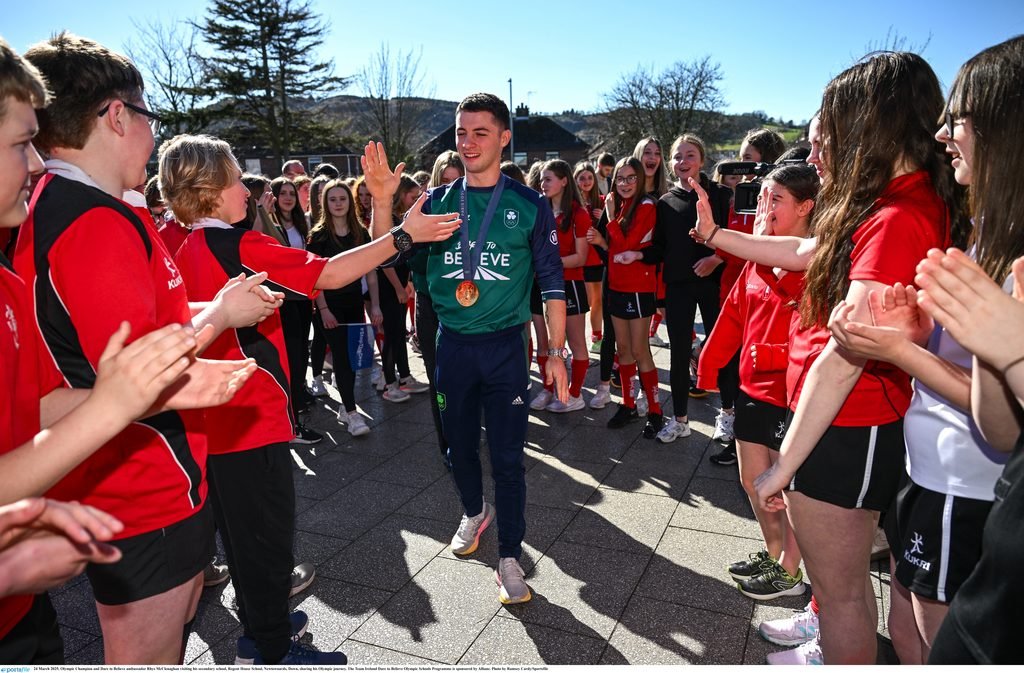
‘It’s the Story, Not the Medal’
One of the clearest findings was the importance of relatability.
Researchers found that students responded to honest accounts of late starts, setbacks and doubts, rather than simply hearing about medals and elite-level achievements.
One athlete ambassador summed up the message by saying: “We’re not superhuman. We’re ordinary people who’ve done some extraordinary things.”
The report describes three elements working together: relatability, through the honesty of the athlete’s story; accessibility, through having that person physically present; and attainability, when a student’s own ambitions begin to feel more achievable.
Dr Eimear Kelly, who led the evaluation, said that sense of “someone like me” could encourage young people to imagine what might be possible for themselves.
Importantly, the effect was not confined to children already interested in sport.
Athlete ambassadors described deliberately trying to reach pupils who might have little interest in competition, while teachers reported seeing some non-sporting students engage with the stories being told.
READ MORE: Every Irish Olympian Now Has Their Story Told in New Team Ireland Archive
Why Being in the Room Matters
The research also found a distinction between watching an athlete on a screen and meeting one.
Students, teachers and ambassadors consistently identified physical presence as an important part of the experience.
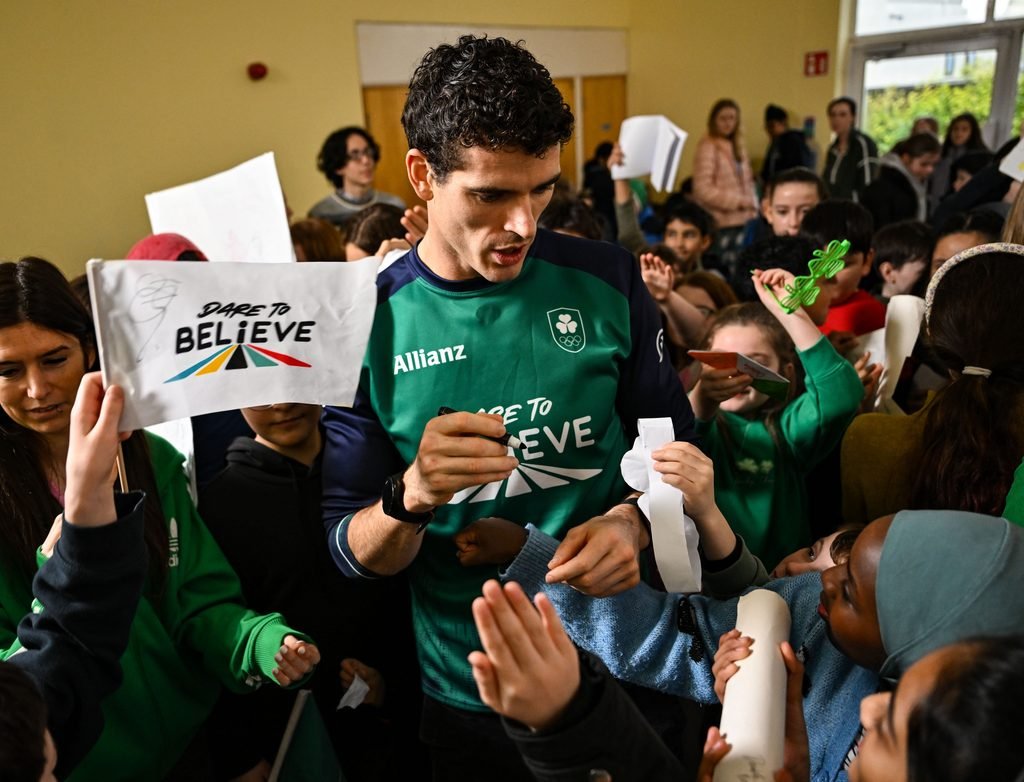
For pupils, some of the most memorable moments were remarkably simple: holding an Olympic medal, getting an autograph or taking part in an activity alongside an athlete.
One primary pupil recalled being allowed to hold a gold medal and being surprised by how heavy it was. Another spoke about keeping an athlete’s autograph at home.
The evaluation concluded that those interactions offered something a video or virtual visit could not fully reproduce.
The quality of the experience also depended on what happened before the athlete arrived.
Researchers found school preparation to be a decisive factor. Visits were stronger when pupils had already worked through the programme, researched the athlete and engaged with its themes, while poorly prepared schools still had positive experiences but generally gained less from them.
What Changed for the Students?
The evaluation found indications that athlete visits could influence how students thought about their own goals.
Some described ambitions beginning to feel more realistic, while others applied messages about resilience to schoolwork and everyday setbacks.
One primary pupil who had been considering quitting an activity said the athlete’s visit had motivated them to continue.
There are, however, important limits to what can be concluded.
The evaluation did not use a control or comparison group and did not directly measure changes in physical activity or sports participation. Most of the accounts of impact came from focus groups held between two and four weeks after a visit.
The researchers therefore describe the findings as perceptions and early indications of change rather than evidence of lasting behavioural change. Impact was not universal, and the limited longer-term evidence found examples both of the message remaining with pupils and of its influence fading.
That distinction is important when assessing a programme built around inspiration. The research suggests the visits can make an impression; it does not claim to have proved that meeting an Olympian produces long-term changes in children’s behaviour.
READ MORE: Meet the Irish: Mona McSharry, Ireland’s Olympic Medallist and World Cup Triple Crown Winner
Athletes Benefit Too
Perhaps one of the more unexpected findings concerned the people delivering the visits.
Athletes reported that participating could provide purpose and perspective, particularly during periods of injury or difficult seasons, while also developing confidence and communication skills.
Among the 16 ambassadors who responded to the survey, all cited communication and public speaking as a positive personal impact, while 86% identified improved confidence and 79% said the experience helped them feel like a positive role model.
The report cautions that the small survey is indicative rather than representative, but describes the perceived benefit to athletes as a finding worthy of further consideration by sports leaders and funders.
For Dare to Believe founder and Olympian Roisin McGettigan, the findings support the idea that lessons from high-performance sport can extend well beyond competition.
“The combination of classroom learning and athlete storytelling is powerful – it gives students tools for life, not just sport,” she said.
Where Dare to Believe Goes Next
The evaluation recommends increasing the number of athlete visits where possible and exploring whether the programme could be extended into sports clubs.
It also calls for further research using a controlled design to examine whether athlete visits add to the impact of the classroom curriculum, with particular attention paid to Paralympic and female athlete role models.
For a programme built around Olympic achievement, however, perhaps the most interesting finding is also the simplest.
The podium gets an athlete through the classroom door. What appears to connect with the children sitting on the other side is everything that happened before they reached it.